
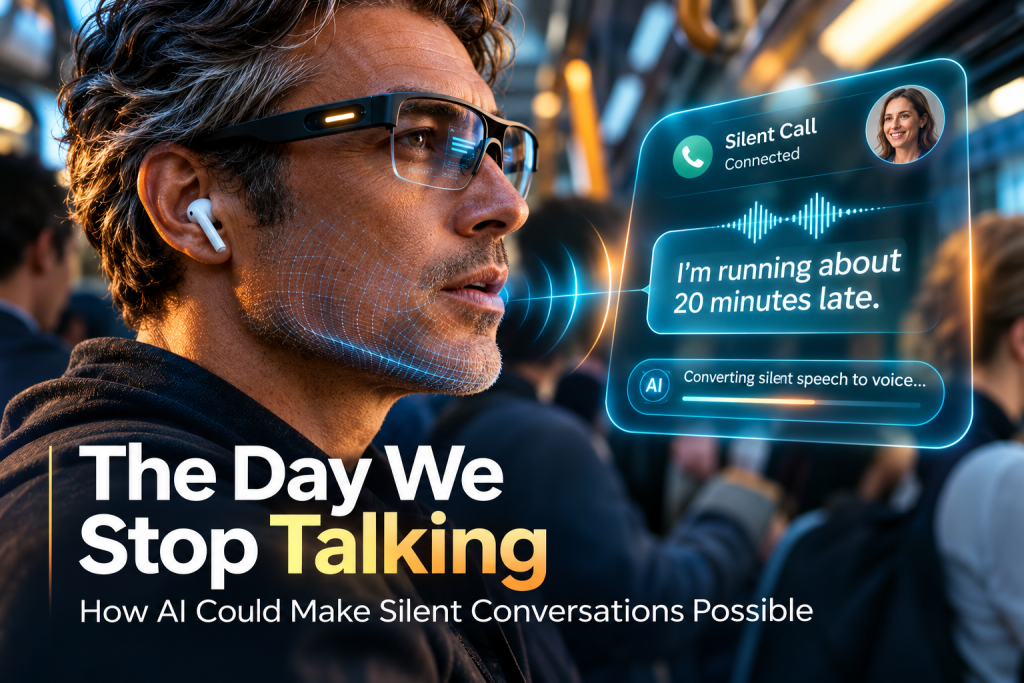
Imagine you’re sitting on a crowded train.
Your phone rings. It’s somebody you need to speak to, but the last thing you want is an entire carriage listening to your conversation.
So you answer the call.
You hear the other person through your earbuds. You respond normally, have a perfectly ordinary conversation, and hang up a few minutes later.
Except you haven’t spoken a single word.
Your lips have barely moved. Nobody around you has heard anything. Yet the person on the other end has heard you speaking in your own voice.
Science fiction?
Perhaps a few years ago.
But after looking at some interesting developments in AI, wearable technology, and silent speech recognition, I’m starting to wonder whether we’re much closer to this than most people realize.
And once you start connecting the dots, the possibilities get pretty interesting.

It started with somebody hacking a pair of AirPods
I recently came across an AppleInsider article about a developer who used Claude Code to unlock head-tracking capabilities in Apple’s AirPods 3 on Linux.
The developer wasn’t modifying the hardware or building a new headset.
The motion sensors were already inside the AirPods.
The challenge was figuring out how to access their data outside Apple’s ecosystem.
Using AI as a coding and research assistant, the developer investigated communication protocols, worked through technical obstacles, and got the AirPods streaming head-tracking information to a Linux computer.
The resulting open-source project, MousePods, lets users control a computer pointer by moving their heads.
Turn your head, and the cursor moves. Other interactions, including holding the pointer over a target, can provide ways to click.
It’s an impressive technical experiment.
But what interested me wasn’t necessarily the mouse.
That’s where my mind started wandering.
Someone just used Claude Code to unlock a hidden feature in AirPods 3: head tracking on Linux.
Dev Matteocean wanted to use the AirPods’ gyroscope to control his mouse, but Linux wasn’t detecting the sensors.
With Claude Code, he found the problem: a Bluetooth packet-size setting was hiding the sensor data. Once fixed, the AirPods started streaming motion data at around 200Hz.
https://t.co/SqGY99QAt1
— Pirat_Nation 🔴 (@Pirat_Nation) November 7, 2026
First thought: What about people who can’t use their hands?
My immediate thought was accessibility.
Imagine someone with quadriplegia or another condition that severely limits their ability to move their arms.
What if they could use small head movements to navigate a computer, operate a communication interface, or control parts of their home?
Move your head to select something.
Hold your position to confirm.
Use AI to turn a simple selection into a complete action.
For example, instead of typing an entire sentence, someone might select “I’m thirsty,” and an AI assistant could help them send a message to a caregiver.
Now imagine combining that with smart glasses.
Rather than needing a computer screen directly in front of them, the person could have a small display within their field of vision.
Suddenly, you’re looking at a potentially useful hands-free interface.
Of course, head tracking won’t suit everybody. Some people have limited head mobility, involuntary movements, or fatigue that makes repeated gestures difficult. Accessibility technology needs to adapt to the individual, not the other way around.
Still, the idea got me thinking.
What if we could have conversations without speaking?
Think about all the situations where talking isn’t particularly convenient.
- You’re sitting in a library.
- You’re attending a conference.
- You’re working in a noisy factory.
- You’re in a crowded restaurant.
- You’re sitting in a meeting and want to ask an AI assistant something without interrupting.
What if you could interact with technology without having to say anything aloud?
Head gestures could be one part of the answer.
A deliberate nod might mean yes. A small movement could select a menu option. Holding your head steady could confirm a choice.
These would need to be designed carefully. Nobody wants to accidentally send a message every time they look around.
And there’s an obvious limitation.
Head movements are useful for selecting commands, but they’re not a particularly practical way to compose complete conversations.
You’d need something else.
Meet Subvocal: Glasses that can detect silent speech
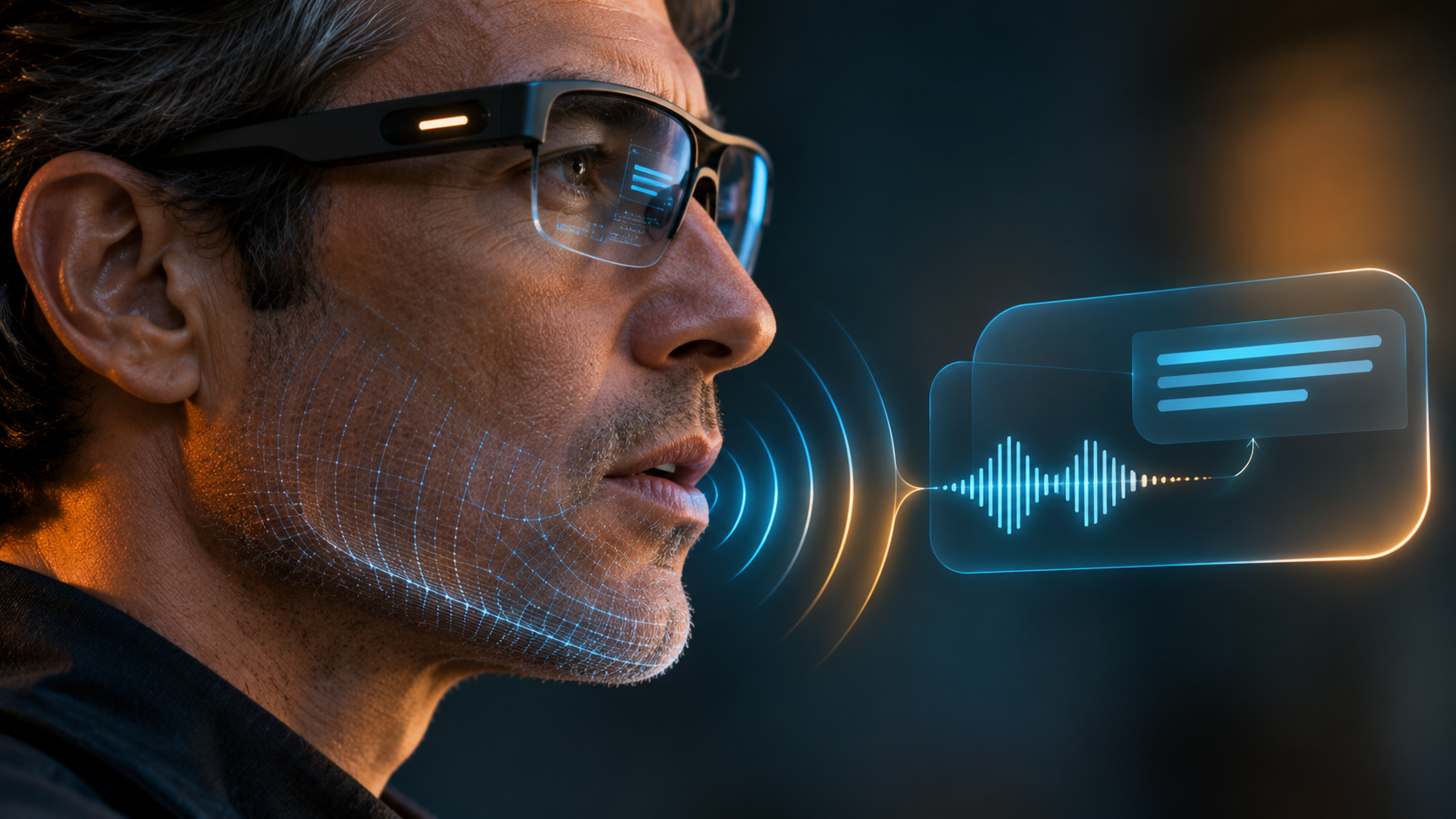
Concept illustration of silent speech being converted into digital communication. Not a photograph of actual Subvocal hardware.A startup called The Subvocal Company is developing glasses that can turn silently articulated words into text.
And this is where things become especially interesting.
Instead of relying on a microphone to hear your voice, the glasses use radio-frequency sensing to detect subtle movements associated with speech.
You deliberately form words without making a sound.
The system analyzes those movements and uses AI to interpret what you’re saying.
The company has claimed input speeds exceeding 200 words per minute. That’s a manufacturer-reported capability, not a guarantee of everyday accuracy or performance.
The glasses are still an emerging product, with initial shipments targeted for 2027.
We’ve raised $1.3M from YC & Afore Capital so you never have to type or speak again.
Typing is slow. Talking into your computer is awkward. Subvocal fixes both
Our glasses give you the speed of speech without you making a sound or touching a keyboard.
It tracks your internal speech muscles with non-contact sensing and decodes silent, almost invisible mouthing into text at more than 200 words/min.
Pre-orders are now live at:
https://t.co/DzrwIpg3GR— Aarush Yadav (@AarushYadav47) October 30, 2026
But the underlying concept isn’t entirely new.
Researchers at MIT Media Lab demonstrated a wearable silent-speech interface called AlterEgo back in 2018.
Their approach used neuromuscular signals associated with intentionally articulated silent speech, allowing users to interact with computing systems without speaking aloud.
Different sensing technology, similar ambition.
But if the technology becomes reliable enough, it could fundamentally change how we interact with computers.
And possibly with each other.
The silent walkie-talkie
Here’s one application that immediately came to mind.
I spent many years working in pubs and nightclubs in Australia, so I know how difficult communication can become when you’re dealing with loud music, large crowds, and situations that need quick decisions.
Security teams often rely on radios.
They work, but you still have to speak into them, and the person receiving the message needs to hear you clearly.
Imagine an alternative.
A security officer notices a problem developing near the bar.
Instead of grabbing a radio and trying to speak over the music, they silently form a message:
Their glasses interpret the words and transmit the message to the team.
Other staff receive it through an earpiece or see it on a small display.
They acknowledge the message with a gesture.
Nobody needs to speak.
Now, we don’t necessarily need full silent-speech recognition for every interaction.
A handful of predefined commands could handle many situations:
- Assistance required.
- Situation under control.
- Medical assistance needed.
- Please contact the supervisor.
- Message received.
Head gestures could select those messages. Silent speech could handle anything more complicated.
The same idea might be useful for event management, emergency responders, industrial teams, or other environments where ordinary voice communication is difficult.
There are even potential military applications where minimizing noise matters, although military-grade systems would need very different security, reliability, and operational safeguards from consumer wearables.
I’m not suggesting we throw away radios tomorrow.
I’m suggesting there might eventually be another communication channel available alongside them.
One that doesn’t require speaking.
Then I had another thought: Why would everybody need the technology?
This is where the idea took another turn.
If two people want to communicate silently, it’s tempting to assume they both need specialized glasses or earbuds.
But what if they don’t?
What if only one person has the technology?
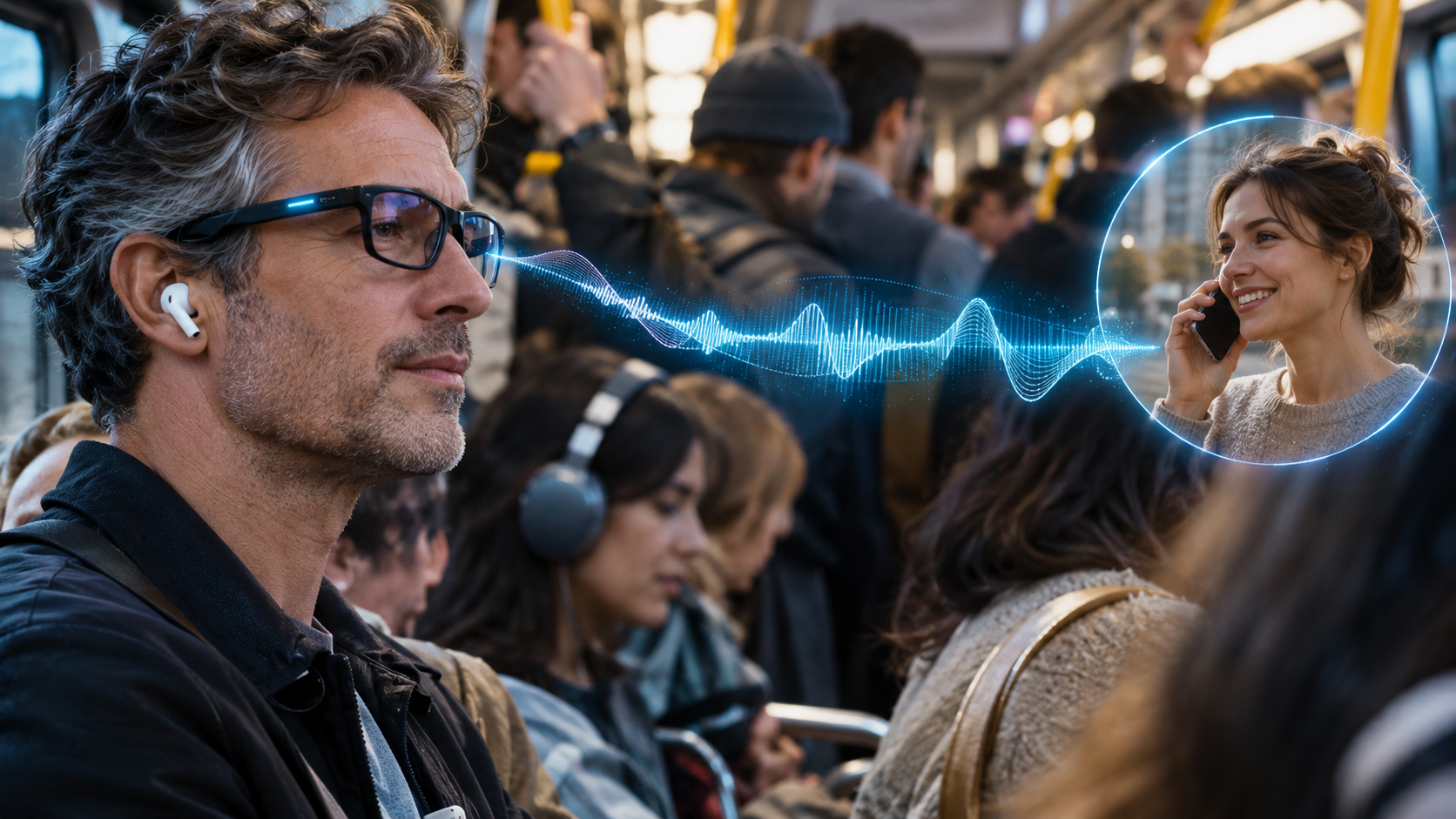
Imagine I’m wearing silent-speech glasses and earbuds, and I want to call somebody.
They’re using an ordinary phone.
No special glasses. No expensive equipment. No new app to install.
I silently form the words I want to say.
The glasses convert those movements into text.
AI converts the text into natural-sounding speech, potentially using a synthetic version of my own voice.
That audio is transmitted through a normal telephone connection.
The other person hears me speaking.
They respond normally.
I hear their reply through my earbuds.
And the conversation continues.
Introducing the SilentVoice concept
I’m not making a sound, but the person I’m talking to hears a normal voice.
A completely silent phone call for one person, and a completely ordinary phone call for the other.
It’s not a product I’ve built, and I’m certainly not claiming to have invented silent speech or AI voice synthesis.
It’s simply a possible application of technologies that are developing independently.
But I think it’s worth exploring.
How would SilentVoice actually work?
The basic architecture is surprisingly straightforward to describe, even if implementing it reliably would be another matter.
A wearable sensor detects deliberate speech-related movements and converts them into text.
AI recognizes the words, handles corrections, and prepares the message for speech output.
Text-to-speech converts the message into natural audio, potentially using a consented synthetic version of your own voice.
A calling application sends generated audio to the recipient, who replies normally while you listen through earbuds.
In principle, none of those individual stages requires inventing an entirely new category of computing.
But connecting them into a fast, natural, dependable conversation is the difficult part.
If every sentence takes several seconds to process, the experience could feel awkward.
If the silent-speech system misinterprets a word, the recipient might hear something the caller never intended.
And if the voice sounds robotic or fails to capture emotion, the experience could feel very different from a normal conversation.
These are real engineering problems.
The accessibility opportunity could be enormous

Although the crowded-train example is easy to imagine, the accessibility applications may ultimately be much more important.
Consider someone who has lost the ability to speak clearly but can still produce some of the muscle movements associated with speech.
Could silent-speech recognition provide another way for them to communicate?
Could AI turn their intended words into a familiar voice?
Could they call a friend or family member without needing the other person to purchase specialized equipment?
There is already significant research in this area.
In 2025, researchers published work in Nature demonstrating a brain-to-voice neuroprosthesis that synthesized speech from neural activity in a person with severe speech impairment.
Another study in Nature Neuroscience explored streaming speech synthesis personalized to a participant’s pre-injury voice.
These are highly specialized research systems, not consumer glasses, and some approaches require implanted electrodes.
But they demonstrate something important.
Restoring natural, expressive communication is already an active area of scientific research.
Silent-speech glasses won’t work for every disability. Someone who cannot produce the necessary mouth or muscle movements may need an entirely different interface, including eye tracking, switches, or a brain-computer interface.
The goal shouldn’t be one universal device.
What about AI assistants and smart glasses?
There’s another possibility.
We increasingly talk to AI assistants, but speaking aloud isn’t always practical.
Sometimes you’re in public.
Sometimes you’re in a quiet room.
Sometimes you simply don’t want the people around you hearing what you’re asking.
Imagine wearing glasses that allow you to silently ask:
- “Summarize the email I just received.”
- “What’s the next appointment on my calendar?”
- “Translate this message into Spanish.”
- “Give me three talking points for my next meeting.”
The response could appear in a small display or be delivered privately through an earpiece.
Combine that with head tracking and you could navigate the interface without reaching for your phone.
The glasses handle silent input.
The earbuds handle audio and potentially head gestures.
AI handles the interpretation and response.
Your phone or another computing device connects everything.
It’s effectively a personal computing interface that requires very little visible interaction.
And that’s where I think wearable AI could become genuinely interesting.
Not because everybody wants another screen strapped to their face.
But because the technology could make computing less intrusive.
Could we eventually communicate just by thinking?
This is where it’s important to separate realistic developments from speculation.
Silently forming words is not the same as thinking them.
A system like Subvocal depends on intentional speech-related movements.
Head tracking detects motion.
Neither technology automatically knows what you’re thinking.
Brain-computer interfaces are a different category of technology, and researchers are making progress in decoding attempted speech from neural activity.
But that doesn’t mean consumer glasses will soon read unrestricted thoughts.
There are enormous scientific, technical, ethical, and privacy challenges involved.
For now, the more realistic direction is technology that recognizes deliberate, silent communication.
And frankly, that alone would be a remarkable development.
What’s stopping this from becoming an everyday product?
Accuracy
Silent speech can be difficult to distinguish, particularly when different words produce similar movements. A system that works in a controlled demonstration may struggle in everyday use.
Speed and latency
Conversations depend on timing. Recognition, correction, voice generation, and transmission all need to happen quickly enough to feel natural.
Comfort and fatigue
Wearing glasses for hours or deliberately articulating every word without sound may become tiring.
Hardware compatibility
AirPods head tracking, silent-speech glasses, AI software, and telephone applications weren’t necessarily designed to work together. Developer access and operating-system permissions matter.
Privacy and security
A system that captures personal conversations must protect that information. Users need clear control over when recognition is active, where their data goes, and how synthetic voices are used.
Cost
Accessibility and communication tools won’t achieve their full potential if the people who could benefit most cannot afford them.
Trust
If AI can generate a voice that sounds like me, it can potentially generate a voice that sounds like somebody else.
That creates opportunities for impersonation and fraud.
Any serious system would need safeguards around voice enrollment, consent, identity, and misuse.
So how far away are we?
I don’t think there’s a responsible way to put an exact date on it.
Some components already work today.
Head tracking can control a computer pointer.
Silent-speech interfaces have been demonstrated in research, and new consumer products are being developed.
AI can generate convincing synthetic voices.
Software can transmit generated audio through telephone services.
But a seamless, consumer-ready system that combines all of those capabilities into a natural silent phone conversation is a different proposition.
My guess is that we’ll see increasingly capable demonstrations and niche applications before this becomes something ordinary people use every day.
Accessibility products, specialist workplace systems, and developer experiments may arrive before mass-market adoption.
Whether that takes two years, five years, or longer will depend on the hardware, software, economics, and the quality of the experience.
And it’s entirely possible that some applications never become mainstream.
That’s the nature of emerging technology.
The bigger story isn’t really about glasses or earbuds
There’s another reason the original AirPods experiment caught my attention.
It demonstrated how AI can help developers discover new uses for existing technology.
The AirPods already contained the sensors.
AI helped the developer understand how to access them.
Now imagine that happening across thousands of different devices.
Sensors in watches, glasses, earbuds, phones, vehicles, and other everyday products could become building blocks for applications their manufacturers never originally anticipated.
Not every experiment will be useful.
Plenty will go nowhere.
But some could solve genuine problems.
And perhaps the next interesting development won’t come from one company inventing a revolutionary new gadget.
Perhaps it will come from somebody connecting three or four existing technologies in a way nobody had previously considered practical.
One final thought
I don’t have plans to build a silent communication system tomorrow.
I’m not a hardware engineer, and I know enough about technology to appreciate how much work would be involved in making something like this reliable.
But I do enjoy looking at emerging technologies and asking what happens when we connect them.
An AirPods head-tracking experiment led me to think about accessibility.
Accessibility led me to silent communication.
Silent communication led me to security teams working in noisy environments.
That led me to radar-powered glasses that can recognize silent speech.
And that eventually led to a simple question:
What if you could call anybody in the world, have a normal conversation, and never say a word?
I don’t know exactly when that becomes practical. But the individual pieces are starting to appear.
I don’t know which company will build it, or whether it will look anything like the devices we’re experimenting with today.
But I think it’s a fascinating possibility worth discussing.
Maybe the future of communication isn’t about talking more.
Maybe it’s about having more choices in how we communicate.
Sources & Further Reading
- AppleInsider — Claude gets AirPods 3 head tracking working on Linux
- MousePods — Open-source GitHub project
- The Subvocal Company — Official website
- MIT Media Lab — AlterEgo
- MIT Media Lab — AlterEgo FAQs
- Nature — An instantaneous voice-synthesis neuroprosthesis (2025)
- Nature Neuroscience — A streaming brain-to-voice neuroprosthesis (2025)
About the author
Andrew McCauley is the founder of Flashlight Agency, where he explores practical applications of AI, automation, and emerging technologies for businesses.
SilentVoice and SilentCom are exploratory concepts, not commercially available products developed by Flashlight Agency. All AI-generated illustrations are conceptual. Proposed integrations are not demonstrated product capabilities.